Most people think rust is just rust.
It’s not.
Two pieces of steel can look almost identical – that same weathered, burnt-orange finish – but behave completely differently over time.
And when you’re building anything outdoors, that difference matters.
What Is Corten Steel?
Corten steel is designed to do something most materials try to avoid, rust.
But it does it in a controlled way.
As corten weathers, it forms a stable oxide layer on the surface. Once that layer develops, it protects the steel underneath and significantly slows further corrosion.
That weathered look isn’t decay.
It’s protection.
What Happens with Mild Steel Outdoors?
Mild steel behaves very differently. It doesn’t stabilise.
It keeps oxidising.
It flakes.
It pits.
Over time, it weakens.
In coastal environments like the Coromandel, that process speeds up even further.
At first glance, it might look similar to corten.
But long term, it’s a completely different story.
Why This Matters for Outdoor Projects
Material choice isn’t just about how something looks on day one. It’s about how it performs over years of exposure.
We see this across:
Fire pits
Architectural features
The wrong material might look fine initially, but it won’t hold up.
Fire Pits That Age Properly
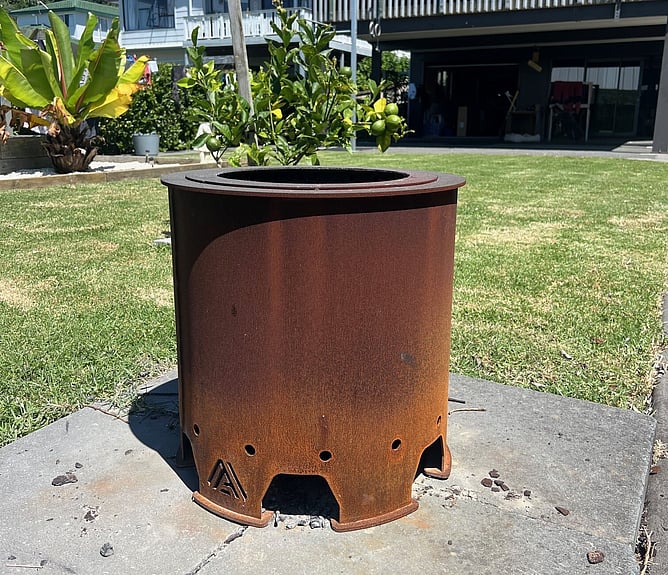
We’ve built smokeless fire pits using corten steel that are designed to live outdoors permanently.
They develop that rich, weathered finish over time – but instead of deteriorating, they stabilise.
Compare that to a mild steel fire pit left outside, and the difference becomes obvious pretty quickly.
One matures. The other breaks down.
Designed for the Coromandel Environment
Working across the Coromandel, we’re constantly dealing with:
Salt air
High moisture
Coastal exposure
Long-term outdoor use
That’s why material selection is never an afterthought.
It’s built into the design from the start.
So, Which One Should You Use?
It depends on the job. Corten is ideal when you want:
A natural, weathered finish
Low maintenance over time
Material that stabilises outdoors
Mild steel still has its place – especially when it’s properly protected through galvanising or coatings.
The key is using the right material for the right environment.
The Takeaway
Two materials can look the same at the start.
But what matters is how they perform over time.
When we design outdoor steelwork, whether it’s fencing, fire pits, or architectural features, the focus isn’t just on appearance.
It’s on lifecycle.
Fit for purpose.
And building something that actually lasts.
Frequently Asked Questions
Is corten steel better than mild steel?
For outdoor use, corten steel generally performs better because it forms a protective oxide layer that slows corrosion. Mild steel will continue to rust unless it is treated or coated.
Does corten steel stop rusting?
It doesn’t stop completely, but it stabilises. The outer layer protects the steel beneath and prevents ongoing deterioration.
Can mild steel be used outdoors?
Yes, but it needs protection such as galvanising or painting. Without it, it will continue to corrode over time.
Is corten steel good for coastal environments?
Corten performs well outdoors, but in harsh coastal environments, material choice should always be considered carefully based on exposure levels.