Not every install comes with fresh blueberry muffins. This one in Pauanui did.
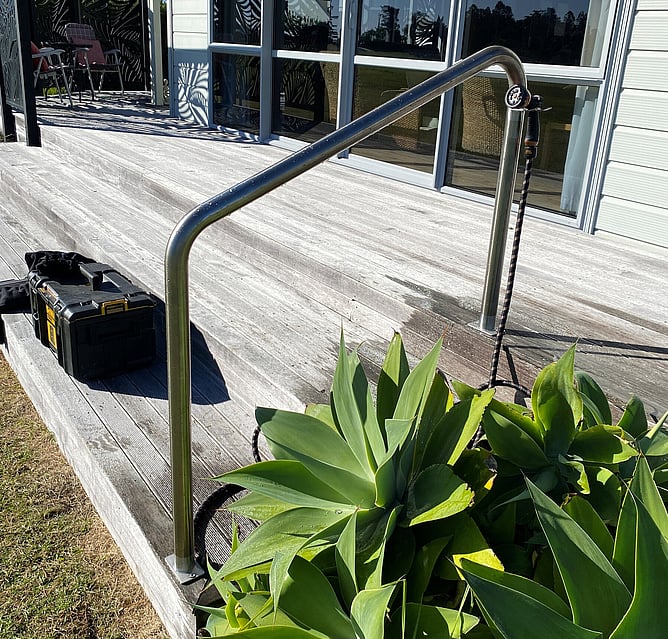
An elderly couple needed a safe way down their front steps. Bennet met them on site, talked through what they needed, and designed a custom 316 stainless handrail to suit the deck and the height that worked for them. Their family lives out of town and were stoked to know mum and dad could safely navigate their own stairs.
It's a small project on the surface. But it sits inside a bigger story about how people live on the Coromandel.
One of the oldest populations in New Zealand
Thames-Coromandel has one of the highest median ages of any district in the country. The Peninsula draws people who have worked hard, raised families, and chosen this part of the world to settle into the next stage of life. Beach houses turn into permanent homes. Holiday baches become retirement bases.
Which means access and safety at home aren't a niche concern here. They're a daily one.
Steps that were fine ten years ago aren't always fine now. Decks built for younger knees need a hand to navigate. Visiting grandkids and ageing dogs both need a way up and down without a tumble.
A well-placed handrail isn't a small thing. It's the difference between staying in your home and not.
What a good handrail actually involves
This job used 316 stainless tube, CNC mandrel bent for clean, smooth curves with no welded joins. 316 is the right call for coastal conditions. It holds up against salt air for decades and won't rust out underneath you in five years.
Mandrel bending matters because it gives you a continuous, comfortable grip. No sharp angles, no welded elbows that catch your hand. The rail flows from the deck down to the lawn the way your hand wants to follow it.
Anchor points are flush-mounted to the deck and sized to take real weight. Not decorative. Designed to hold an adult who has slipped.
And there's a small touch worth noting on this one: a hook for the garden hose, welded straight onto the rail. Hose holders usually disappear into garden beds. A purpose-made one at the top of the steps keeps it tidy and to hand.
Real homes, real surprises
Most off-the-shelf rails are sized to a generic step. Real homes have real angles. A custom rail follows the actual deck, the actual stairs, the actual height of the people using it.
It also means dealing with what you find when you start the install. On this job, when Bennet pulled up the decking planks to fix the rail, the brace beams weren't where he'd expected them to be. No drama. Off to the store, back with what he needed, job sorted that day.
That's the part that doesn't show up in the photos. Designing it properly upfront, then sorting whatever the site throws at you when you get there.
Access work across the Peninsula and Waikato
Alted does this kind of work across the Coromandel and into Waikato. Custom handrails, ramps, accessible deck modifications, balustrades that meet code without looking institutional.
Every job is designed in SOLIDWORKS first so the geometry, the angles, and the anchor points all work the way they should before any steel is cut.
If you've got a parent, a grandparent, or you yourself are looking at a set of stairs and thinking "those are getting harder," it's worth getting on top of it before there's an incident.
Drop us a line. We'll have a look, take some measurements, and quote what's needed. Designed properly, anchored properly, and built to last in coastal conditions.