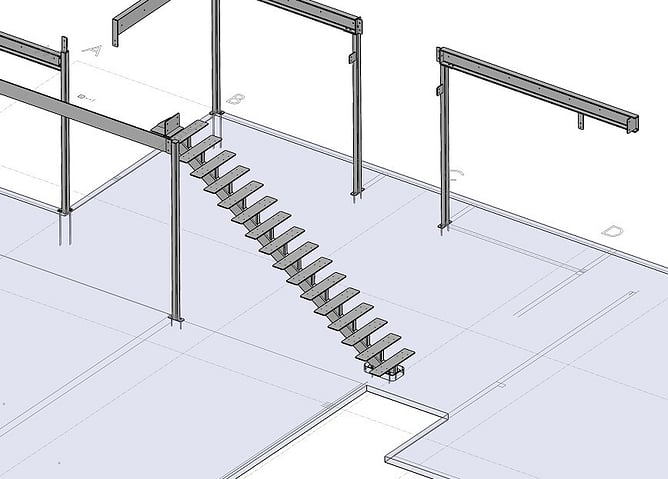
Preliminary. IFA. IFC.
They might look like small notes on a set of structural steel drawings, but they tell you something pretty important: where those drawings are in the process – and whether they're ready to build from.
At Alted Engineering, our structural steel drawings move through defined stages before fabrication and construction. Understanding which version you're looking at helps make sure everyone – builder, architect, engineer and fabricator – is working from the right information.
And the most important rule is pretty simple.
If a drawing isn't Issued for Construction, it shouldn't be used for construction.
Preliminary drawings
The drawing process starts when we receive the architectural and engineering information for the job and begin developing the structural steel working drawings.
Early versions are marked Preliminary because there are still details to work through.
Dimensions may need confirming. Connections might need resolving. There may be questions around positioning, fabrication or how the steel interacts with other parts of the build.
Preliminary drawings give us a way to work through those details and share information with the project team without suggesting that what they're looking at is ready to build from.
The distinction matters: Preliminary drawings are not for construction.
IFA: Issued for Approval
As the working drawings develop and the required information is resolved, they reach the next stage: IFA: Issued for Approval.
This is the review set.
The drawings are issued to the main contractor and, where required, shared with the architect and engineer so the relevant details can be checked and approved before the job progresses.
This is also where Alted's mechanical design and engineering capability comes into play. Detailed working drawings allow us to resolve how components will be fabricated, connected and ultimately fitted on site before steel starts being made.
An IFA drawing may look complete, but its status is important.
It's ready for approval. It's not yet Issued for Construction.
IFC: Issued for Construction
Approval moves the drawings into their final stage.
Any required changes are incorporated and the drawing set is reissued IFC: Issued for Construction.
That's the version to work from.
It sounds straightforward, but on a busy building project there can be multiple versions of drawings moving between different people. An early PDF gets saved. A printed set ends up in a site folder. Someone forwards an older email.
Suddenly, the drawing someone has in front of them isn't necessarily the latest one.
So if you're looking at an Alted structural steel drawing on site, check the status.
If it says Preliminary or IFA, stop and check you've got the latest set.
You want IFC.
Why drawing control matters with structural steel
Steel isn't particularly forgiving when the information is wrong.
A beam needs to be the right length. Bolt holes need to be in the right place. Connections need to work. Steel may need to fit within timber framing or line up accurately with concrete foundations and other structural elements.
By the time our structural steel reaches site, we want as much of that thinking and problem-solving completed as possible.
Good drawing control helps everyone work from the same information and reduces the risk of confusion, rework and delays.
It doesn't need to be complicated.
Preliminary: we're still working through it.
IFA: it's ready for approval.
IFC: it's ready for construction.
Three small labels. One very important difference.